When I consider my reasons for gardening, it has to be said that it simply feels right, to be gardening.
Without a connection to nature, to natural forces, I'd feel I wasn't living in this world.
Since I was young, however, I've witnessed a disrespect for nature that shocks me. So, in gardening, I make some attempt to rectify that, to rectify what I see as the damage done in this world, by human beings. I want my garden to offer space to creatures pushed out by our development.
I'm thrilled then to have found this Tawny Frogmouth ( Podargus strigoides ) sticking around, at his station in our apple tree, for a number of weeks now. Related to owls, frogmouths are largely insectivorous. I was sort of hoping they'd be after mice too, for they, the mice, have been making their presence felt here!
Not to matter. You somehow know the world's a better place when wild creatures feel quite OK living beside you, so discreetly, so unperturbed.
Tuesday, May 21, 2013
Friday, May 17, 2013
Connectedness
It was the poetry that came out of the First World War that first got me interested in that catastrophe. It spoke of a profound and absurd waste of life. That war was the first in which modern weaponry and in which mass destruction were implemented. To me, as I'm sure to others, it's the saddest of wars.
More recently, I've got interested in the Second World War. Perhaps because it was the war my parents' generation endured, or perhaps because its mechanization reduced its participants to data, I'd not felt it to be as aching as the First.
But my feeling has changed. Any war is bad news. In any war there's ridiculous suffering. There can be no such thing as a necessary war. To think that any of us has to have war as their life experience is to me horrendous...war does nothing but destroy humanity; its purpose opposes what we're really meant to be doing.
Reading John Verney's account ( Going to the Wars ) - he with such a light, humane, candid touch - I know now that being caught up in that war would have been ineffably painful. This post honours all who suffered in it. My excuse for posting it here is that, to me, gardening, as an act of constructiveness and peace, of continuity and well-being, challenges and resists futility.
For anyone interested, John Verney's obituary in The Independent is excellent. He is described there as a "painter, writer and illustrator," a man devoted to his wife and children, and to his friends.
Sir John Verney ( 30/09/1913 - 02/02/1993 ) wrote, in this, "one of the best memoirs of the Second World War."
More recently, I've got interested in the Second World War. Perhaps because it was the war my parents' generation endured, or perhaps because its mechanization reduced its participants to data, I'd not felt it to be as aching as the First.
But my feeling has changed. Any war is bad news. In any war there's ridiculous suffering. There can be no such thing as a necessary war. To think that any of us has to have war as their life experience is to me horrendous...war does nothing but destroy humanity; its purpose opposes what we're really meant to be doing.
Reading John Verney's account ( Going to the Wars ) - he with such a light, humane, candid touch - I know now that being caught up in that war would have been ineffably painful. This post honours all who suffered in it. My excuse for posting it here is that, to me, gardening, as an act of constructiveness and peace, of continuity and well-being, challenges and resists futility.
For anyone interested, John Verney's obituary in The Independent is excellent. He is described there as a "painter, writer and illustrator," a man devoted to his wife and children, and to his friends.
Sir John Verney ( 30/09/1913 - 02/02/1993 ) wrote, in this, "one of the best memoirs of the Second World War."
Thursday, May 9, 2013
Plans and Maps: the Done and the Undone and the Yet to Be Done.
I'd been planning to visit Victoria Gardens in High Street, Prahran for some time, passing as I frequently do on the Number 6 tram. Hidden from the street, I didn't know what I'd find there; I imagined it might be dull, municipal, under-used. It is, in fact, a 5 acre oasis, bordered along its length by the back fences of neighbouring homes, which homes capitalise on their privileged views.
Many locals came and went, with their dogs, with their friends or alone, while I was there. Without what you'd call an exceptional design or planting palette, it is nonetheless much-used, tranquil, easy on the senses.
I'm reading Paul Theroux's The Pillars of Hercules: A Grand Tour of the Mediterranean ( 1995 ). His intention was to circle the Mediterranean, clockwise, from Gibralter to Ceuta. He appears to have had no distinct plan other than this, over 18 months; I marvel that he just takes me along with him as he bumbles along the coast. He is erudite, open-minded. He isn't drawn to ruins or to sights or sites. He talks to you, the reader, as his confidant.
One of the delights of blogging is finding your plans undone. I'd intended to report on Victoria Gardens in a thorough and considered way, reporting on it as if it and my experience mattered. What happened was that I found my garden photos were of little use...the gardens themselves were not especially arresting, or the unusually strong sunlight bleached my images, or I wasn't particularly interested in yacking on about a place no-one will go to.
Paul Theroux didn't much like Taormina in Sicily and didn't visit its Greek theatre. ( "Nothing held me in Taormina." ) Though favoured by the Edwardians, and visited by a poetry-writing D H Lawrence, "...these days it exists only to be patronized and gawked at. It was not a place to live in, only to be visited, one of the many sites in the Mediterranean that are almost indistinguishable from theme parks." ( P 179 )
I, however, would probably traipse here, being fond of ruins, if they are not tourist draw-cards. Above is an image of the theatre itself, taken from a little book I've found, Provincial Art: Southern Italy and the Islands, published in 1957 by the Italian State Tourist Office.
But I am in Melbourne, and I'm recording pictures of statuary, garden furniture. So far, almost 2/3rds of the way through The Pillars of Hercules, it's Corsica I'd most like to visit. Its fountains would be older than this bit of Victorian Neo-Classicism, but it's graceful here, this fountain, in one of Melbourne's inner suburbs.
Victoria Gardens were " formally dedicated for public use" on 07 August 1885. They were laid out by William Sangster, "well-known gardener and nurseryman of the firm Taylor and Sangster." He was "once the gardener to John Brown of Como and was responsible for landscaping works at Stonnington, Rippon Lea, Daylesford Botanic Gardens and Wombat Park," so a little sign informs.
The gardens include this pergola and some stone shelters of a simplistic nature. There is a large "oval depression in the centre" the size of a small soccer field "and a symmetrical layout of paths." There are London Plane, Macadamia, Jacaranda, Plum Pine, Cape Chestnut, Prickly Paperbark, French Hawthorn, Lombardy Poplar, Yew, Lemon-scented Gum, Southern Magnolia, among others. Anything tough, vaguely Victorian.
I decided there wasn't much point elaborating on a garden whose chief merit was the joy it gave to all those bumbling in, if, from a visual point of view, its plantings and design were unexceptional. So, assuming some of the cheek of a travel writer who takes you where he wills, here above is one of the entrance gates, spearmint green, sort of Art Deco, just right against the treescape.
Beyond the Pillars of Hercules was the Unknown, the world beyond the Mediterranean, all that was chthonic. My plan had got skewed. I was somewhere unknown, but it was local and it wasn't frightening. I find that Paul Theroux doesn't exclude the tedious or ugly. He takes you where he goes, awkward or sublime, without judgement. He believes he's traveling alone, but I feel I'm looking over his shoulder.
Above, the statue of Victory, "supposedly a copy of one erected in Berlin to commemorate the Battle of Waterloo," or the Prussian victory in the Danish-Prussian War, depending where you read. Victory, to me, REAL victory, entails a dissembling of self, a preparedness to 'get lost', an acknowledgement that the places we go to, whether they are far or near, have the propensity to shake us up a bit out of our known self.
Saturday, April 27, 2013
If the Choux Fitz...
I was hanging around Smith Street, Fitzroy, early as usual, waiting for Ian.
If you're bored here, you'll be bored everywhere.
In this first of Melbourne's suburbs, age is celebrated. And so is youth.
So is all of life, in all its sudden glory.
We got to lunch before too long, to La Niche. But I'll digress, and take you to Heide Museum of Modern Art, where I wandered afterwards,
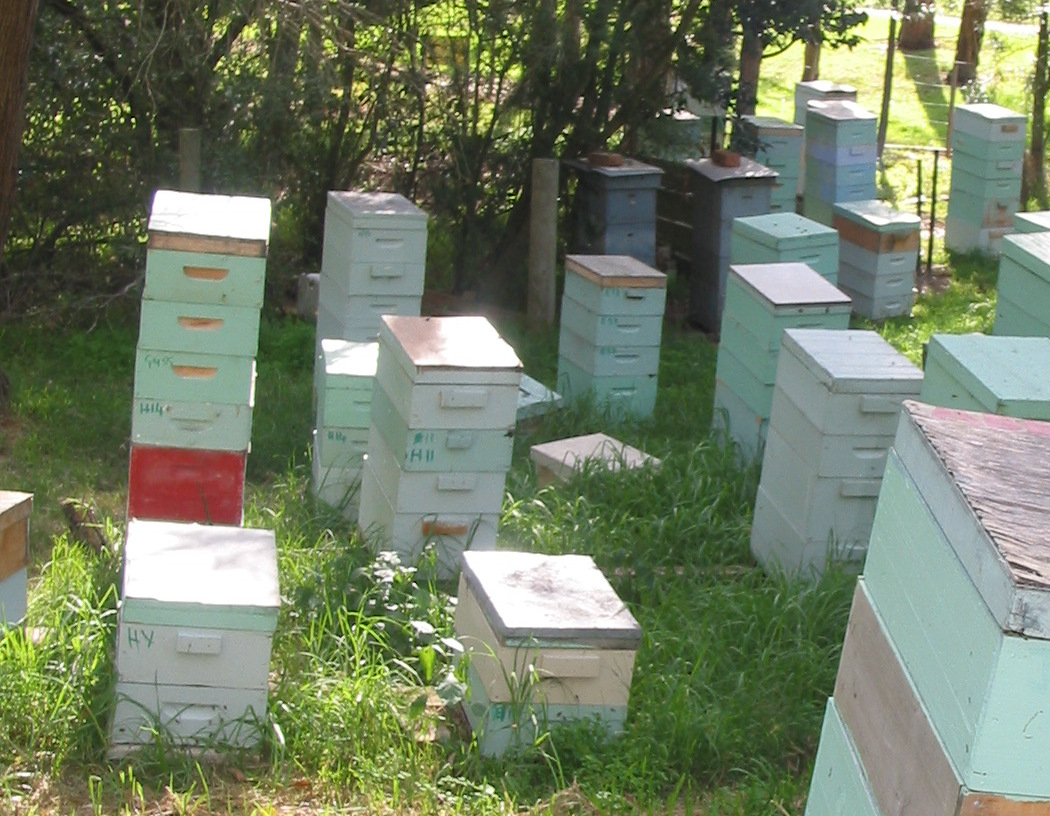
among the bee hives
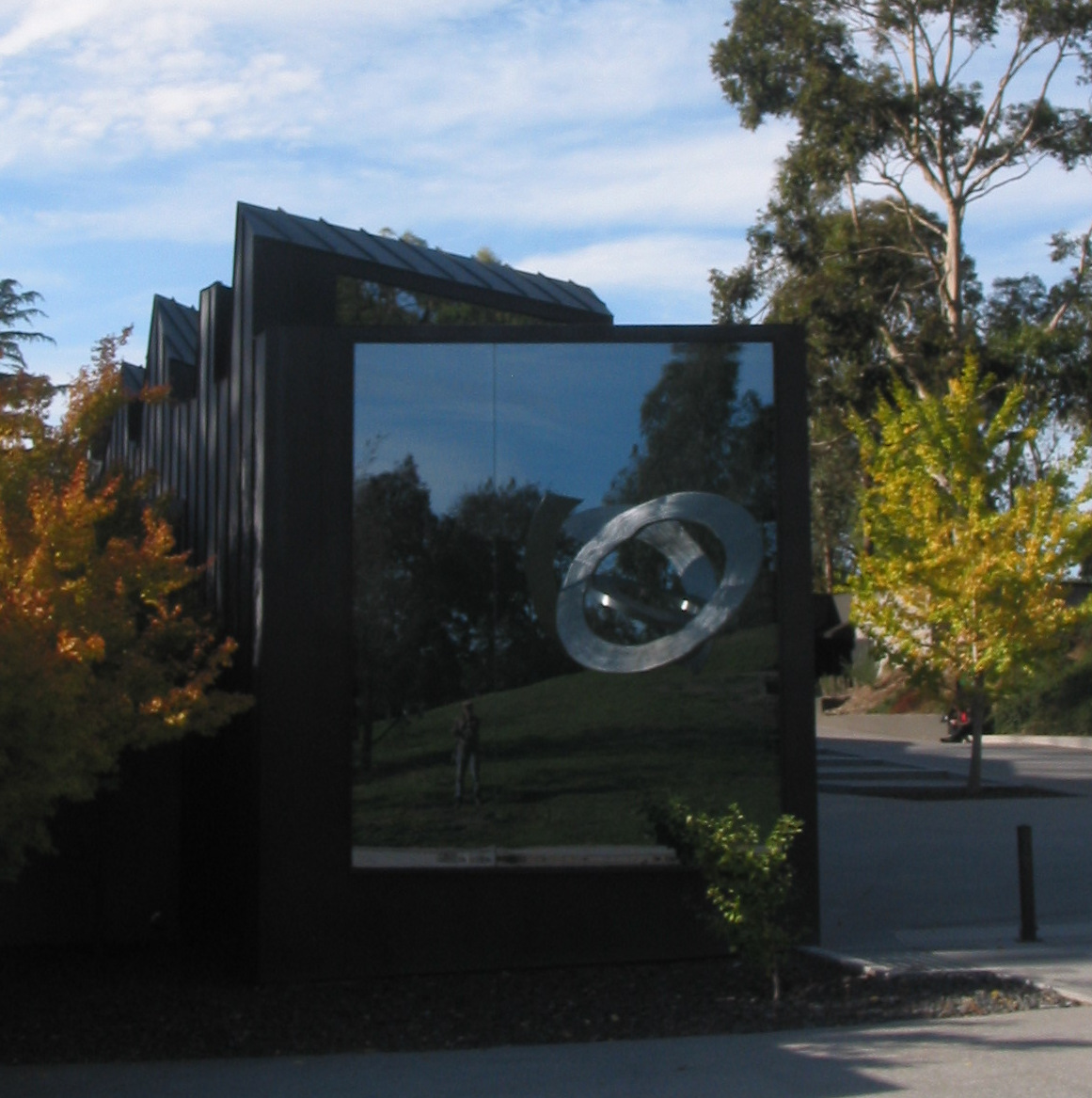
and the sculpture.
A good friend, French food, art, gardens...I didn't miss out on much today.
Jeff Thomson's Cow ( yellow ), 1987, with some neighbouring moos.
Sixties domestic architecture at its best.
Like Fitzroy, Heide is always re-inventing itself. Both, they are, prepared to take on the new, to mesh the new into their identity.
'In the presence of form II', 1993, by Amish Kapoor. I was listening to children shout inside it to hear the echoes.
I've posted this most elegant sculpture before, Andrew Rogers' 'Unfurling'. So beautifully feminine.
Return now, if you will with me, to Smith Street, where amongst the Victorian grandeur, the dingey digs and the newest of architecture, home-owners are creating native gardens.
It's a streetscape begging for inventiveness...
...which it gets in spades, or in carousels.
A piece from the 'Exquisite Palette' exhibition.
After all this running around, before and after lunch, I was delighted to eat my beef burgundy, authentically French. Our waiting staff, one fully clued in her delicious hat, the other extempore, in her evening dress, served us with grace and humour. I prefer to eat my lunch than photograph it, so, below, see a poster on the premises:
Everyone is welcome, choux-less or not.
Friday, April 19, 2013
Word Garden
Heffernan Lane, in Melbourne's Chinatown, is nondescript, an alley, really, full of grimy back-doors...
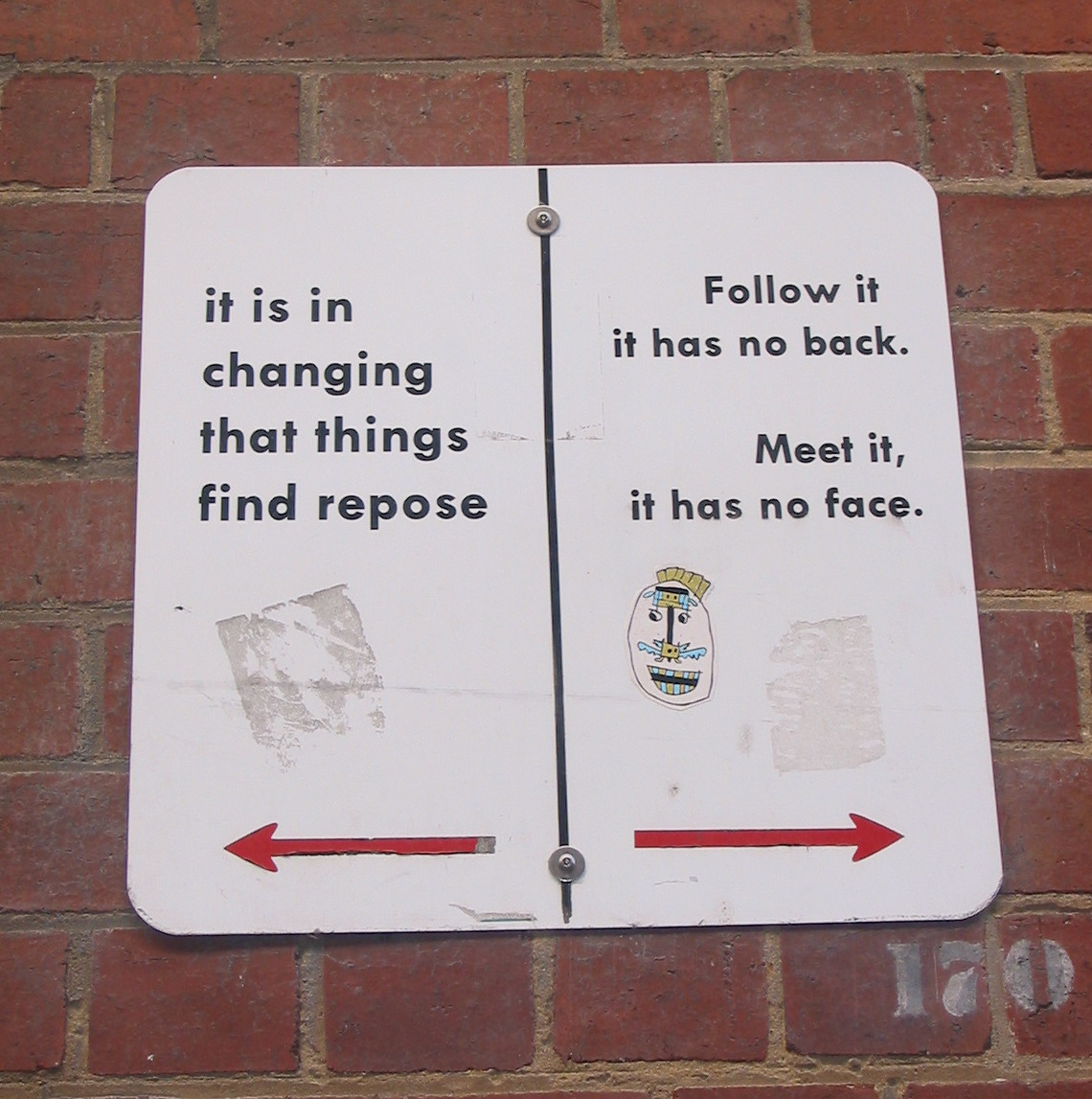
...but it's here that artist Evangelos Sakaris was commissioned by the City of Melbourne in 2001-2002 to install his innoccuous and unexpected group of apparent street signs, 'Word and Way.'
A commercial hub, there've been, of course, in this knot of streets, all sorts of signs mounted to keep the traffic moving. How would I be, or even want to be, a nuisance here, now, gazing at these wonderful texts?
This is street art that makes you stop. The delight in finding a message not designed to be practical, but to open your heart is more than disarming -
- it puts a spring in your step. A cloud floats above the rational world. You aren't going to have the message thrust in your face. It's waiting for you.
What's so charming to me about this sharing of ideas, in a corner pedestrians otherwise avoid unless obliged, is the inconspicuous naivety, here where the bricks are sullied with years of labour and worldliness.
Art happens, and all of us have a contribution.
"If you open yourself to loss, the lost are glad to see you." How much I connect with this, I cannot tell you. To hear someone else say it, blows me away.
Right now I'm reading Byron Rogers' biography of the eccentric Welsh poet R.S.Thomas. His words, too, those of the poet, go straight to the heart of what is felt within what is visible.
I'm sure he'd have got a chuckle here; I'm sure he would have felt calmed in recognising an approach, a philosophy? sensible and caring.
This is art seriously un-serious. It gets added to, or bits fall away. No matter, it's been involved in the lives of us, here, wandering the streets, tired, perhaps, of advertising and warnings, of being sensible and of clocking into language as if it were made to define the world, instead of to lead us into it...
The work of the artist resides within a locale forever shifting. New work intervenes. I'm so very grateful to live in a city where art is allowed, somehow encouraged, enabled.
"The softest overcomes the hardest." Inarguably, that is the case here.
Subscribe to:
Posts (Atom)